Why a Financial Advisor needs a unified data layer to scale
Why a Financial Advisor needs a unified data layer to scale
The modern RIA toolstack is powerful — and painfully disconnected
Over the past decade, most Financial Advisors have adopted an impressive mix of specialized tools and platforms to manage clients, portfolios, and planning workflows.
They use CRMs for relationships, custodial portals for transactions, portfolio systems for reporting, financial planning apps for modeling, and internal files for custom calculations — each solving a clear need on its own.
However, these systems rarely “talk” to each other seamlessly.
What looks like operational sophistication often hides a deeper inefficiency: advisors and client-service teams spend large portions of their day reconciling data between platforms rather than advising clients.
Today’s RIA toolstack — why data gets scattered
Most Financial Advisors juggle several systems that don’t communicate natively:
- Custodian portals (e.g., Charles Schwab, Fidelity) — account records, transactions
- Portfolio reporting (e.g., SS&C Black Diamond, Orion) — performance, billing, householding
- CRM (e.g., Wealthbox, Redtail, Salesforce) — contacts, tasks, interactions
- Email & calendar (Microsoft 365/Outlook or Google Workspace) — day-to-day communication
- Notes & knowledge (OneNote, Notion, Evernote) — meeting notes, checklists, internal SOPs
- Meeting transcriptions (Otter, Fireflies, Grain) — call summaries and action items
- Financial planning (RightCapital, eMoney) — plans, assumptions, client goals
- Document storage (SharePoint, Google Drive, Box/Dropbox) — statements, reports, client files
- Ad-hoc spreadsheets — one-off trackers and “shadow” data
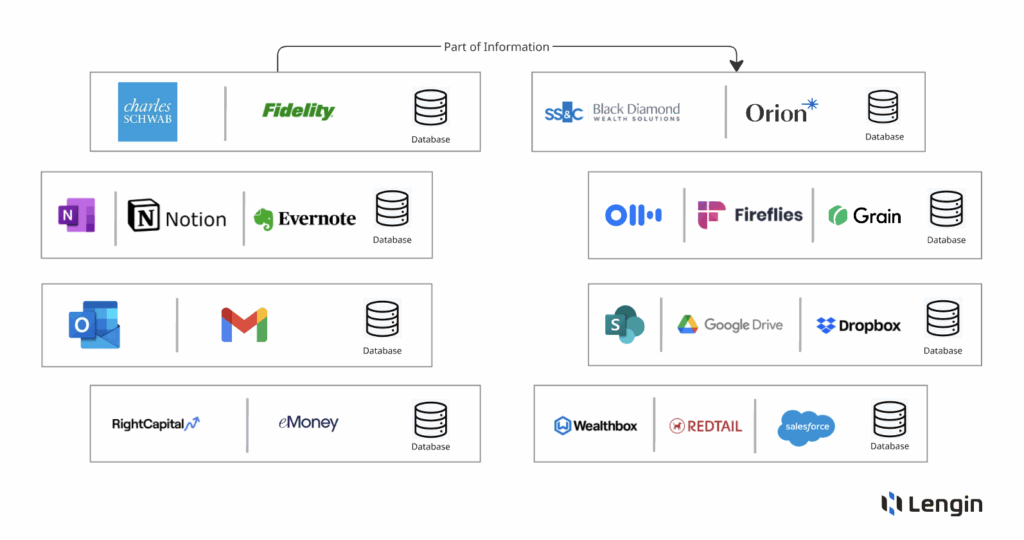
As a result, pieces of the same client story live in different tools, with partial overlap and frequent drift. Advisors and support teams often spend hours locating the right version of a file, confirming data consistency, or preparing context for client meetings.
The real problem: fragmented data creates fragmented client experiences
When data lives across multiple registered investment advisor software platforms that don’t integrate natively, context is lost – and efficiency drops.
In other words, Financial Advisors can’t instantly see the full picture of a client’s financial life – not because they lack data, but because the data is scattered.
That disconnect affects everything:
- Preparation for meetings becomes repetitive and manual.
- Follow-ups rely on memory and notes rather than reliable automation.
- Compliance reviews take longer due to inconsistent data sources.
- Team collaboration suffers, as everyone works from slightly different “truths.”
Ultimately, these inefficiencies ripple outward, affecting how clients perceive responsiveness, trust, and personalization — the core elements of a strong advisory relationship.
The case for a Unified Data Layer
The foundation for solving these challenges isn’t adopting yet another app.
Instead, the key is connecting existing registered investment advisor software systems through a unified data layer. It serves as the connective tissue between all systems, ensuring that information flows consistently and reliably.
To achieve that, firms can take several practical steps:
- Establish a central client data model — a single source of truth for households and accounts
- Use a data lake or warehouse to aggregate information from custodians, CRMs, planning tools, notes, and communications
- Designate the CRM as the operational hub, with bi-directional sync to key systems like reporting and planning
- Automate the flow of emails, meetings, and notes into structured CRM records
- Keep files in a document management system (SharePoint, Drive, Box) and link them contextually to client records
- Govern the entire pipeline with field mapping, deduplication, and validation to prevent drift
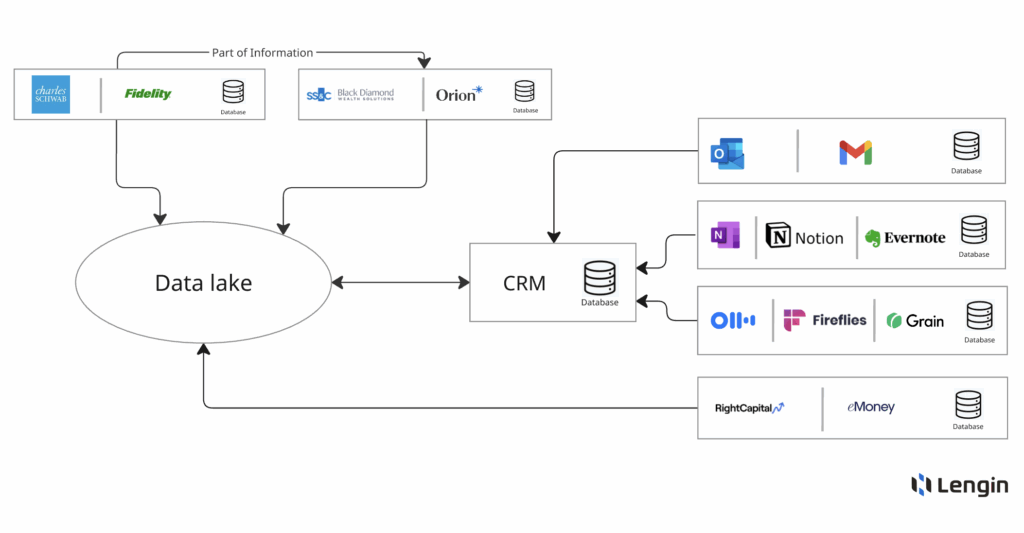
Once that’s achieved, advisors can search once (within the CRM) and have complete, up-to-date information surfaced instantly from every integrated source.
From Fragmentation to Intelligence
Once the data foundation is unified, it opens the door to intelligent automation. With consistent, clean data, Financial Advisor can use automation to prepare meeting briefs, detect missing documents, or generate client summaries with minimal manual input.
Importantly, this approach doesn’t require replacing your current registered investment advisor software – it connects and enhances it, transforming data into intelligence. Think of it as building connective tissue between technologies, rather than starting over.
For example, a unified pipeline can automatically summarize meetings from Outlook and OneNote, update CRM records, and attach related portfolio snapshots — all without manual touchpoints.
As a result, Financial Advisors gain context instantly, support teams save hours weekly, and clients experience smoother, more consistent communication.
Looking ahead: the AI Copilot
Finally, once data integration is in place, adding an AI Copilot layer becomes the natural next evolution.
An AI assistant can leverage unified data to draft personalized summaries, prepare meeting briefs, or identify next-best actions — helping financial advisor focus on relationships rather than logistics.
While that’s a topic deserving its own deep dive, the foundation remains the same – without unified data, no AI layer can truly perform.
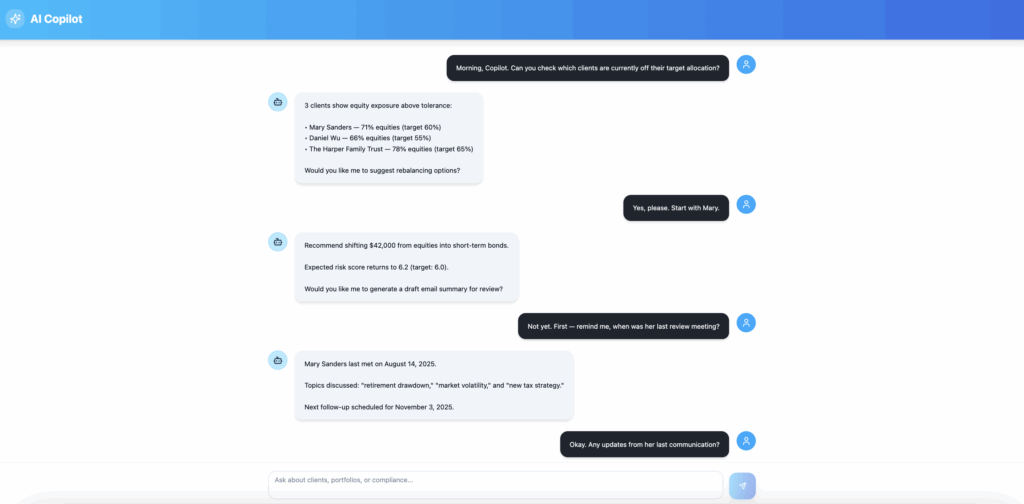
To explore how AI Copilots transform daily advisor operations, see our previous article: “How AI Copilots Are Redefining Efficiency for RIA Firms in 2025.”
Key Takeaway
In short, the competitive edge for RIA firms won’t come from adopting more software — it will come from connecting the tools they already use.
Unifying client data doesn’t just improve accuracy; it unlocks efficiency, strengthens trust, and lays the groundwork for intelligent automation that truly enhances human advisory work.